


Publisher: Qira’at Afriqiyah Magazine
Issue: 65, July 2025
ISSN: 2634-131X
Year : 21
Pages: 40-53
Author: Mohammad Ahmed Abadi & Islam El-Mansy
Download pdf
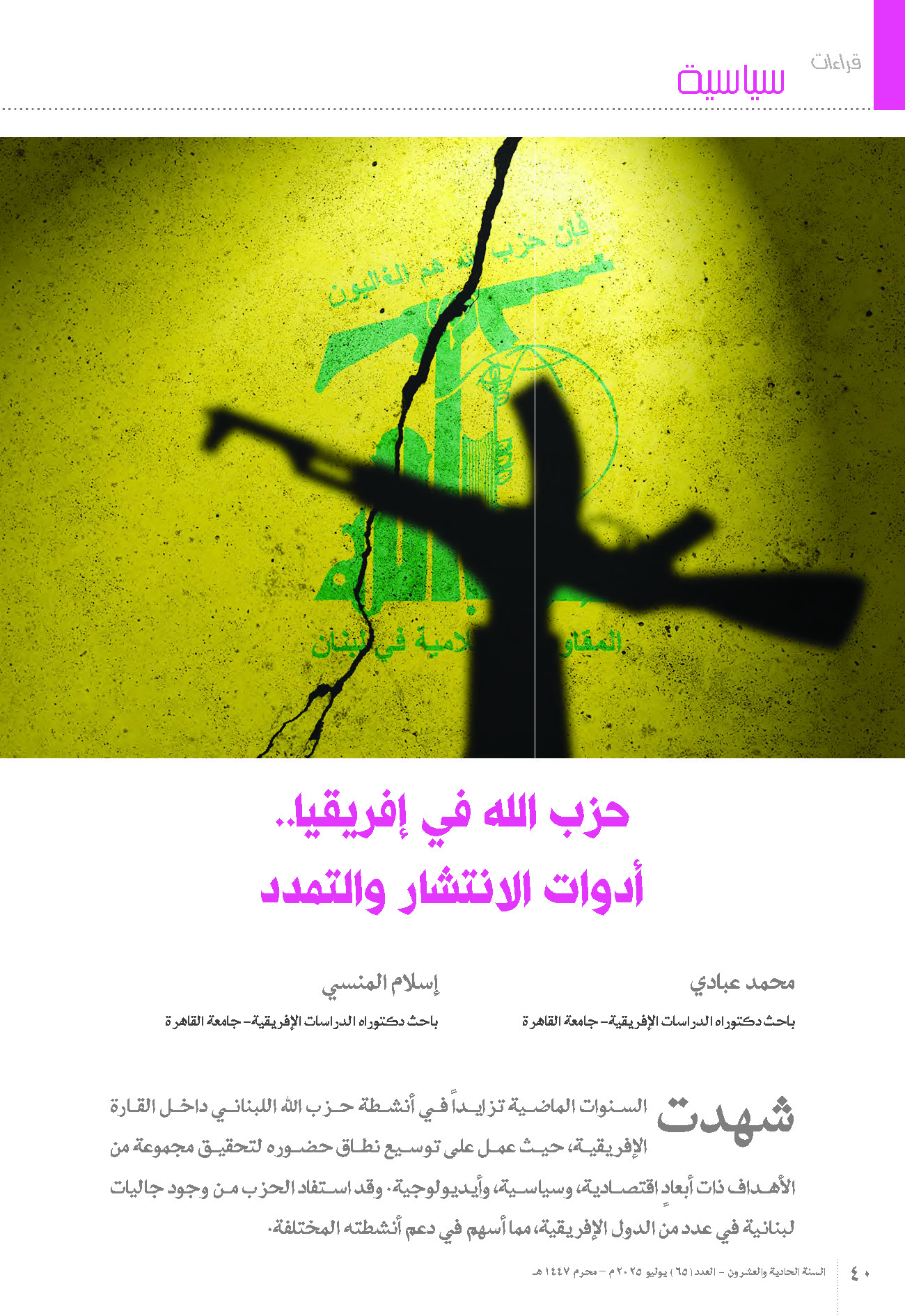
Abstract:

This study examines the expansion of the Lebanese Hezbollah in the African continent, revealing its motivations, tools, and religious, political, and security impacts. The movement was founded with Iranian support in the early 1980s and transformed from a local military organization into a transnational entity relying on a broad network of cultural, economic, and military relations. In Africa, Hezbollah established a strong infrastructure by leveraging the widespread Lebanese Shiite communities, particularly in West African countries such as Ivory Coast, Nigeria, Senegal, and Guinea-Bissau.

Economically, the party relied on charitable institutions and commercial networks to secure funding, such as the “Al-Qard al-Hasan” association, in addition to its involvement in illicit activities including money laundering, drug trafficking, and diamond trade, which provided alternative income sources amid international sanctions. It also used family-owned businesses linked to the Shiite diaspora as a cover to finance its activities and transfer funds through complex and hard-to-trace methods.

Militarily, Hezbollah established secret cells in cooperation with the Quds Force of the Iranian Revolutionary Guard, providing training and arms to local militias, as in the Nigerian case with the “Islamic Movement of Nigeria” led by Ibrahim Zakzaky, which led to violent confrontations with the state. The party also exploited weak security controls to smuggle weapons and build logistical support networks.

Culturally, Hezbollah employed media and religious tools to spread Shiite doctrine and strengthen loyalty to Iran through channels like Hausa TV and affiliated educational and religious institutions. It successfully gained support from segments of African Shiite communities that engaged in its diverse activities.

However, in recent years, the party has faced major challenges, most notably the assassination of its key leaders last year, including Hassan Nasrallah, the party’s historic secretary-general, which caused disruptions in its leadership structure and difficulties in maintaining contact with external networks, especially in Africa. Additionally, the decline of its influence in Lebanon and tightening scrutiny over its financial transfers may limit its ability to fund overseas operations.

Therefore, Hezbollah’s future in Africa depends on its ability to adapt to geopolitical changes, shifting regional balances, and the volatility of Iranian support amid increasing international pressure. This may compel it to reformulate its strategy in Africa to avoid contraction and the loss of gains
accumulated through decades of covert and overt work.