


Publisher: Qira’at Afriqiyah Magazine
Issue: 70, October 2026
ISSN: 2634-131X
Year : 22
Pages: 46-69
Author: Prof. Hamdi Addul Rahman Hassan – Egypt
Download pdf
Abstract:

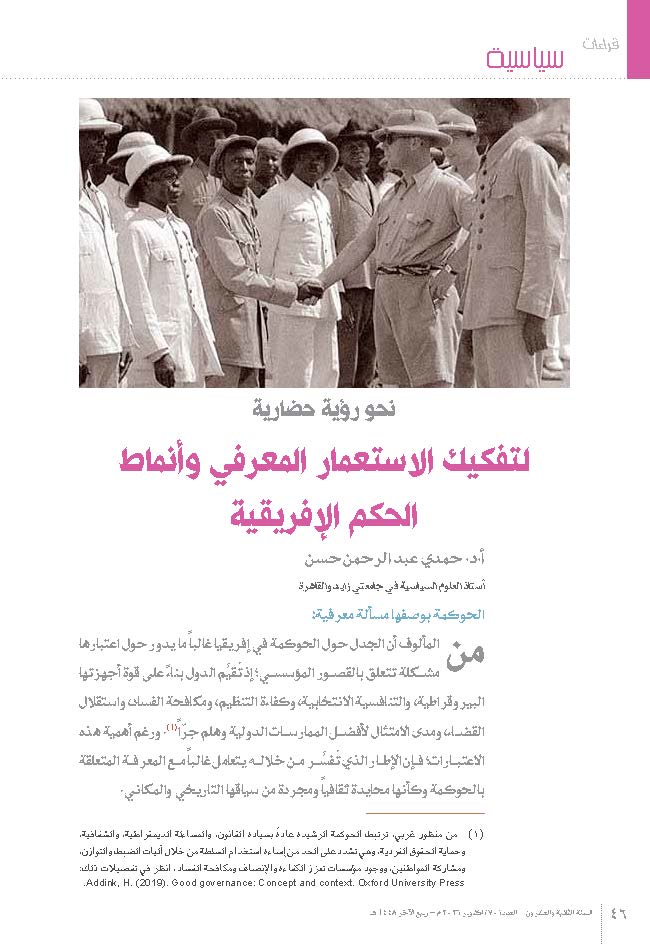
The post-colonial African state occupies a position defined by an evident paradox: on one hand, it is the product of artificial borders and bureaucratic and legal frameworks inherited from colonial rule; on the other, it is expected to embody the sovereignty of peoples whose political traditions predate the colonial era—and who, in fact, endured systematic repression during it. Consequently, this externally imposed state has become a burden on its own societies.

Colonial rule did not merely impose foreign institutions; it also transformed knowledge into a tool for domination and influence. It delegitimized traditional political systems while selectively codifying "indigenous customs" to facilitate administrative control. Decades after formal independence, this structural legacy persists.

The resulting dilemma cannot be resolved through the mere token integration of traditional local concepts into institutions whose classifications, conceptual frameworks, and standards of validity remain externally imposed. True decolonization, from a civilizational perspective, requires a reconstruction of knowledge. This process entails reclaiming Africa’s diverse traditions of political thought—such as the concept of civilizational identity, consensus-oriented deliberation, and restorative justice—subjecting them to democratic scrutiny and human rights standards, and engaging them in a dialogue with contemporary constitutional principles. This study argues that governance approaches in Africa must move beyond superficial reforms of inherited institutions, while simultaneously avoiding a romanticized restoration of pre-colonial political forms. Instead, civilizational systems such as (Gadaa) and constitutional principles derived from (Ubuntu) philosophy should be treated as sources of political theory rather than mere folklore. The goal is not to construct an African system based on the exclusion of the culturally different "Other," but rather to establish an Africa that possesses epistemic sovereignty and can contribute its own civilizational resources to global discourses on democracy and justice.