


Publisher: Qira’at Afriqiyah Magazine
Issue: 67, January 2026
ISSN: 2634-131X
Year : 22
Pages: 104-115
Author: Prof. Dr. Ibrahim Sobhi Elsayed Ghandar – Egypt
DOI: 10.64665/qirat.2026.2206707
Download pdf
Abstract:
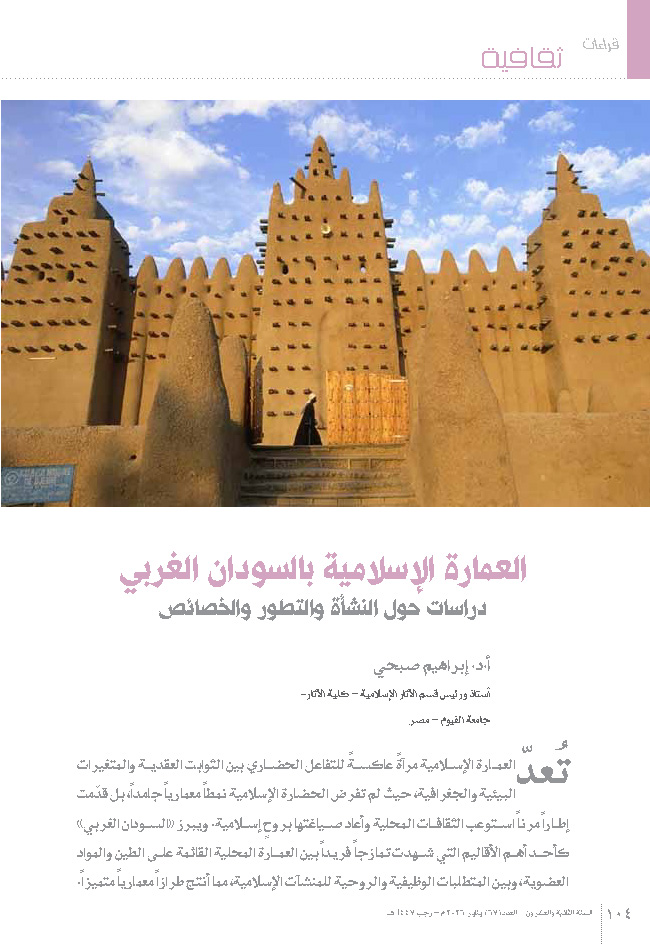
     Islamic architecture is a mirror reflecting the cultural interaction between doctrinal constants and environmental and geographical variables. Islamic civilization did not impose a rigid architectural style, but rather presented a flexible framework that absorbed local cultures and reformulated them with an Islamic spirit. West Africa stands out as one of the most important regions that witnessed a unique fusion between local architecture based on mud and organic materials, and the functional and spiritual requirements of Islamic structures, resulting in a distinctive architectural style.
     Despite the visual and technical richness of this style, studies that address the geometric and structural analysis of this architecture still need further development and expansion. This study aims to shed light on the architectural components in the West Africa region, specifically in the cities of Timbuktu and Djenné in the Republic of Mali. This research provides an overview of Islamic architecture in Western Sudan, from the early days of Islam›s arrival there until the mid-20th century, and how the characteristics of the ancient and medieval periods of local history in these regions were reflected in the architecture.
     The article addresses the topic through the following analytical axes:

      Axis One: General features and characteristics of Islamic architecture in Western Sudan.

      Axis Two: Architectural origins of the Islamic architectural style in the Western Sudan region.

      Axis Three: Architectural examples (the Great Mosque of Djenné).