


Publisher: Qira’at Afriqiyah Magazine
Issue: 58, October 2023
ISSN: 2634-131X
Year : 19
Pages: 6-19
Author: Ahmed Mohammed Ahmed Ismail
Download pdf
Abstract:

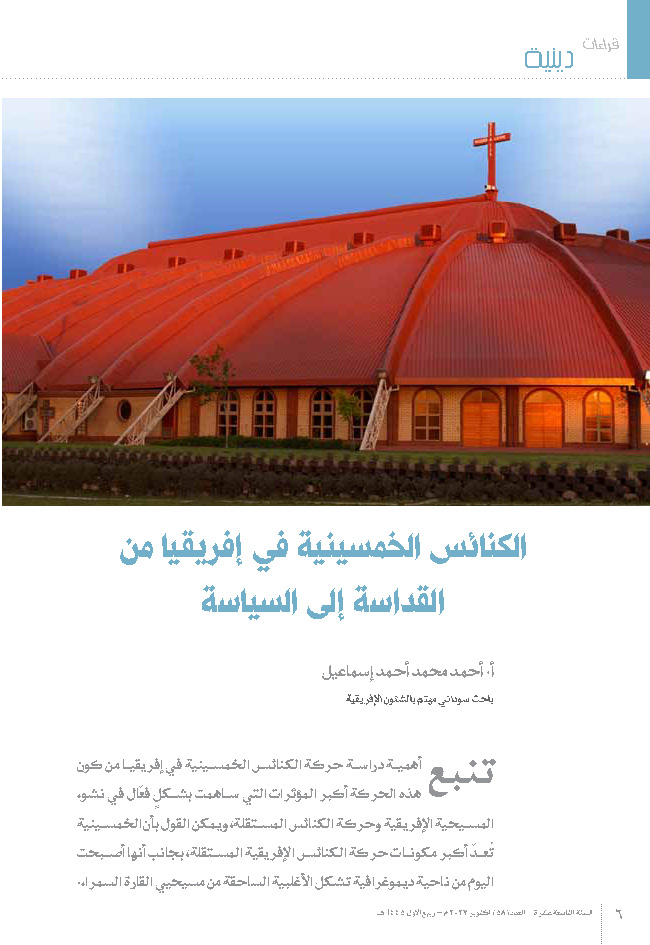
Pentecostalism is considered an African production, initiated by Americans of African descent who challenged traditional ecclesiastical power and the functional priesthood hierarchy across the United States and the Americas. Their doctrines liberated Christianity from rigid clerical traditions, shifting it toward accessible, grassroots expressions that moved outside church walls and into public spaces. They subsequently extended this profound influence globally, particularly to Africa, where Pentecostalism converged with the resistance of African Christians against the hegemony of historic mission churches. Its flexible theological frameworks absorbed traditional African heritage and spiritual worldviews within an indigenous Christian context, positioning Pentecostalism as a primary pillar of African Christianity.

After securing dominance within ecclesial spaces and the hearts of African believers to become the continent's fastest-growing Christian movement, Pentecostalism leveraged its grassroots popularity to expand into wider public life, transitioning from theology into politics. It capitalized on its massive constituency to sway electoral outcomes—elevating select leaders while sidelining others. Consequently, political figures, regardless of their personal affiliations, routinely courted Pentecostal leadership, marking a prominent instance of the political instrumentalization of faith.

In this context, Pentecostalism engaged in significant political confrontations with Islam in Africa, attempting to curb its expansion even in demographic powerhouses such as Nigeria. There, it actively mobilized against the implementation of Sharia provisions in northern states and opposed Nigeria's accession to the Organization of Islamic Cooperation (OIC). Similarly, in countries where Muslims constitute a minority, such as Kenya, Pentecostal bodies strongly resisted constitutional provisions that formally recognized Kadhis' courts for Muslim personal status issues.

Pentecostalism perceives the expanding Islamic presence across the continent as a fundamental challenge to its own spiritual and social influence. While Pentecostalism originally gained traction by providing an alternative to colonial-era ecclesiastical structures that alienated indigenous culture, it now contends with an Islamic framework that integrates smoothly into African cultural realities while addressing day-to-day socio-economic needs through distinct institutional and religious paradigms.