

Publisher: Qira’at Afriqiyah Magazine
Issue: 69,July 2026
ISSN: 2634-131X
Year : 22
Pages: 6-19
Author: Dr. Rania Hussein Khafaga – Egypt
Download pdf
Abstract:
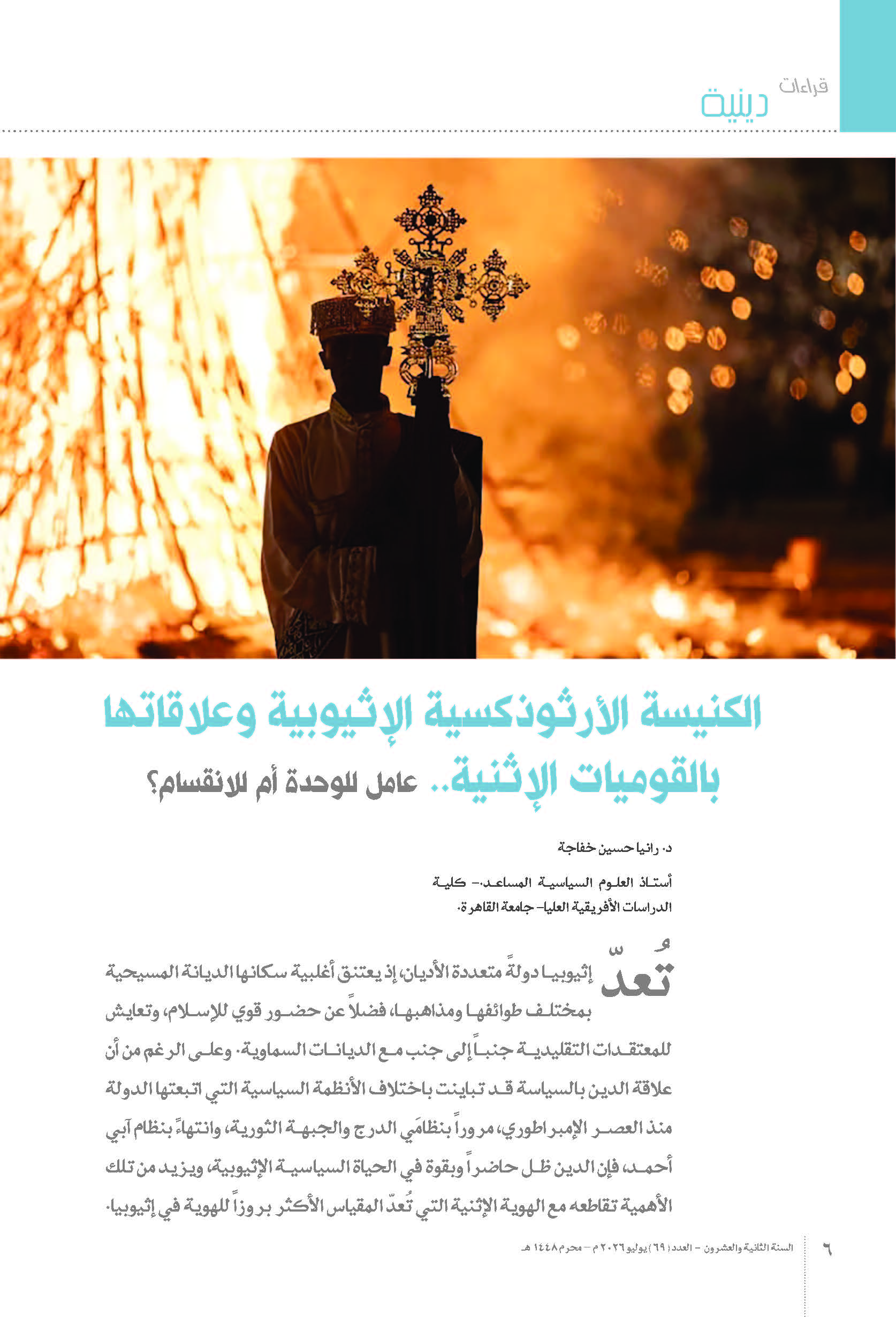
Ethiopia is a multi-religious country, with the majority of its population adhering to Christianity in its various denominations and sects. Islam also has a strong presence, and traditional beliefs coexist alongside the Abrahamic religions. Although the relationship between religion and politics has varied according to the different political systems the country has followed since the imperial era, through the Derg and EPRDF regimes, and up to the current government of Abiy Ahmed, religion has remained a powerful presence in Ethiopian political life. This importance is further amplified by its intersection with ethnic identity, which is considered the most prominent measure of identity in Ethiopia.

The past few years, particularly since Abiy Ahmed assumed power in 2018, have witnessed significant transformations that have posed numerous challenges to the Ethiopian Orthodox Church. These challenges have arisen both from within the Church itself - manifested in a series of schisms where ethnicity played a prominent role - and from outside, with some members converting to competing Christian denominations such as Protestantism and Catholicism. These transformations are particularly significant given their clear intersections with ethnic and even regional dimensions.

In this context, this paper seeks to examine the evolving relationship between the Orthodox Church and the various ethnic groups in Ethiopia, and whether the Ethiopian Orthodox Church - as the representative of the Orthodox faith - is a factor of unity or division within Ethiopian society.

Therefore, the study is divided into four main sections. The first examines the reality of Orthodoxy and other Christian denominations in Ethiopia. The second discusses the relationship between the Church and the State in Ethiopia, and how this relationship has fluctuated between polarization and repression. Finally, the third and fourth sections address the relationship between Christian denominations and different ethnic affiliations.